


I’ve been on substack for almost as long as I’ve done the pod — about three years. One thing I learned and learned quick: there are a bunch of people way smarter than me on this thing. For instance, a couple weeks ago I made the humbling decision to subscribe to Mary Harrington’s page. You can just tell that lady’s relationship with the English language is like a long fingered hand in a soft white glove. Beautiful all the way through. Mostly I can grasp what she’s writing about, but the combination of those cleverly-wrought sentences with the sheer volume of her output makes me think I’d better start looking for a hammer-swinging kind of job soon.
Nevertheless, he persisted.
I was always better at trying hard than, you know, knocking anyone’s socks off with my undeniable amazingness, so, clumsy sentences aside, there might yet be room for people like me in the ole Sub-tent. After all, I’ve been a relentless motherfucker about showing up. I mean, how else do you get to 100 episodes?
To that end, the 100 episodes end, I’m throwing a party for all of us at the Morse Code Podcast. We’re having a celebration show — live, one night only — at the 5 spot in East Nashville this Thursday April 16. Nice and early at 6p. We’ll have musical performances from several guests from the show, an author interview with Tyler Merritt, a short film screening from Joy Todd and Randa Newman, and live painting from Ryan Rado. If you’re within driving distance, I would men a lot to me if you came. Go here and buy a ticket. If this show if anything like the last one we did, it will be like young magic. Which is obviously the most potent kind.
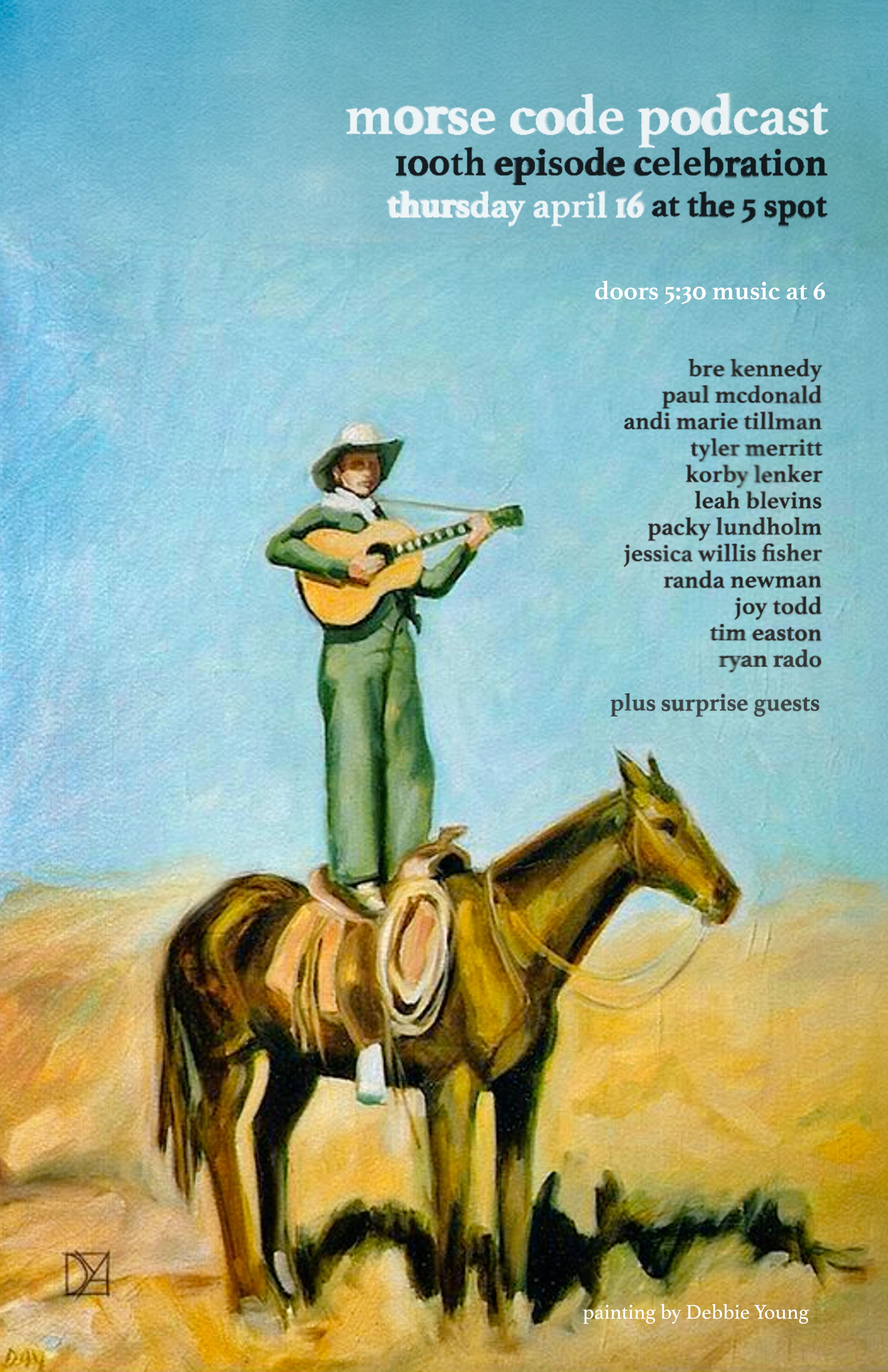
What a great poster, come on! The story of how I found this image, and the lengths I went to to secure the permission to use it, and what happened after, merits the telling. So, below the below, and assuming I can get to it before the baby wakes up, I’ll share it (Addendum: I ran out of time. That story soon).
But first, some insights from a guy who started a podcast and didn’t quit.
Let’s start with a positive.
1. I think I’m good at it
Meaning, the actual talking/listening deal. I’m terrible at small talk longer than 3 minutes (ask anyone) but 60 minutes of conversation about what lies underneath a passionate person’s effort to share something authentic and true about themselves? Hold my beer.
Some of the success of a deeper conversation has to do with the guest’s basic willingness to be vulnerable. But assuming everybody wants to be seen and understood, the onus is really on the host to make the guest feel comfortable and safe and respected. It’s in those fecund conditions the guest is most likely sprout a flower. A good example of this is was my conversation with Liam St. John. We’d never met before the taping, but his willingness to get at some of the more personal aspects of what drives his songwriting and performing, the things he’s insecure about — made his one of my favorite episodes.
I feel a little weird about saying this, but the respect has to go both ways. If the guest thinks you’re a chump, the conversation on the podcast will be just like real-world equivalent — it’s going to be bad. To me, part of what separates the Morse Code Podcast from others (in the musical space at least), is that I don’t come at it from the perspective of a critic or a journalist. While those folks play an important role in the culture, they have the privilege and protection of being once-removed. They’re not throwing themselves into the humiliating crucible of creative generation in the same way artists do.
With me, no such distance obtains! I think the guests sense that, even if we’ve never met before the taping. Few people have made the kind of sustained sacrifice necessary for making a life in art over decades. I’m one of them. It’s a kind of self-forging that cannot be negated. There’s a confidence in the center of all that self-doubt. Therefore I’m not afraid to talk to anyone. You may be more famous than me. Hell, you might be more talented, but your commitment to the work is not greater than mine, I promise. I will pull out my own fingernails with a found pair of pliers if that’s what it takes to write one more meaningful story.
2. I’m not very good at it
The marketing I mean. Like a lot of arty types, I’ve never been great at turning the head of a passing stranger. That’s a different kind of skill then, you know, creating the compelling internal arc of a well-drawn character over 300 pages. Some people I know are good at both. Which, well isn’t that nice?
I’ve tried different fonts, different photos, more photos, less photos. I’ve paid for things like Thumbnail Tester which is where you create several different thumbnails and title combinations and it runs tests on them to see which one performs best. I’ve watched endless videos explaining how to make exactly the right thumbnail. I’ve tagged reposted paid for things that didn’t work, in short, I’ve spent more time trying to market the podcast than I have working on the thing that brings me joy. This makes me a little sad. One of the stupidest things about the self-checkout line that is modern distribution for music, writing, movies is that you have to spent your extremely valuable time trying to do something you’re probably not very good at. I notice being hot helps, or funny, or best — both.
3. It’s gotten better over time
Three years is a pretty good stint. Every aspect of the podcast has improved over time. A lot of that is because of my producing partner, Jared Hammond. His dedication to excellence is —well if you’ve ever watched a clip on instagram you can see it on display. We have a beautiful product mostly because of him.
4. The money question
Candidly, and I’ll have to approve this disclosure with Randa before I share it — the Morse Code Podcast has lost a lot of money. You could send a kid to a middle-tiered private school for what we’ve spent on these hundred episodes. And that’s not factoring in my time, which is at least 30 hours a week (I remain unpaid shakes fist at the cheap bastards running this show). That’s what they call in the business, a pain point.
Originally the intention of the podcast was to supplement the main project — a TV pilot we made called Morse Code about an indie folk singer trying to make a career in music and be a good dad — with a real-world analogue featuring actual artists doing their versions of what the main character Simon goes through. This, along with a novel I wrote of the same name. The idea was that all these three efforts would conspire to bring a buyer to the table, and we would sell the pilot and everything would be okay. Cut to two years after the pilot hit the film fest circuit (not to mention the seven years prior while I was writing and filming the web series prototype), and despite my efforts, nothing has happened except a protracted absence of sleep.
One of the things I focused hard on was driving paid subscriptions to the substack to offset the costs of the podcast. The trick was, how do you make the podcast free so it will get discovered by passersby and at the same time get people to pay for it. My latest solution — which hasn’t really worked — was to pair each free episode with a reflective personal essay and to put that essay behind a paywall. The amount of time I spend on these 1000 words essay is laudably impressive or wildly dumb, especially considering that I think I’ve gotten one paid sub for about twenty essays.
The wash hasn’t been total. This will not be a surprise to you for whom writing’s primal benefit is the joy of knowing what you feel by describing it faithfully — those essays have been instrumental in creating the kind of satisfaction necessary to sustain all the other mundanities I’ve had to push through to make the pod go. Like, probably 70% of my time is spent posting captioning tagging. It’s super teenagery, except that teenagers are way faster at it than me. I’ve tried to farm it out to another voice, but it hasn’t so far worked. It’s kind of got to be me making the words.
That said I think on balance, it probably hasn’t been worth it, writing those essays (They are under the category After the Conversation. We’re still losing too much money and it seems like sharing personal insight does not a profit make.
Okay I gotta wrap this up.
This Thursday the 100th episode comes out. If I were more confident in my marketing chops I was say something snazzy like “Have a guess as to who the 100th guest will be? Comment below!” But I will just tell you. It’s Molly Tuttle. Three time Grammy-winner, bluegrass super flatpicker. During the episode she plays a song we wrote together called “Friend and a Friend.” If you want you can watch this video of the two of us playing it back in 2016, shortly after we wrote it. The conversation was fun and I’m proud to share it.
But here’s a little catch, which is that I started the podcast as a supplement to my main desire which was to make meaning out of the world with my own art (songwriting and short stories mostly). Over the last three years, the podcast has taken over everything and made the kind of unstructured time necessary to creative work increasingly hard to come by. If I pan back a little, I see something that hurts and makes me scared. Which is that I broke off touring and writing songs and making albums to do this — make Morse Code. I wanted to tell a story that I felt was, on the one hand, true to me, and on the other hand, true to anyone else who honored a calling, even as they watched how it affected the people around them. It was and is a worthy story. Practically speaking, making an indie TV show was an enormous gamble. I am kind of feeling like the gamble might not pay off, and I don’t quite know what to do next. Saying this out loud is maybe dangerous, but also, it could provide some solace or camaraderie to someone out there to tried for a long time for something that didn’t work out the way they hoped it would. I don’t know. Here we are.
After the 100th episode we’ll have a few more, but then I’m going to take a little break and figure out what’s next. To be honest, since having a kid it’s more important to me to be a good a dad and husband than to achieve some kind of extraordinary worldly success. Lately the effort to make this thing pay has been motivated largely by my determination to prove that my creative efforts could contribute meaningfully to the financial well-being of my family. I’m tired. I think I need to take a break and maybe find something that will pay a little better.
Reader, hark: attach no sad face to this paean to the uncertainty of trying. I salute every person who dares to make something wonderful, including me. I will be fine, and hopefully, I will see you Thursday, here or at the Five Spot. Thank you. Korby